
Anxiety disorders are the most common mental health condition in the United States, affecting roughly 40 million adults. Effective treatments exist — SSRIs, SNRIs, cognitive behavioral therapy — and they help many people substantially. The patients who end up researching ketamine are typically not the ones those treatments helped. They are the ones who completed adequate medication trials, who did the therapy, who followed the clinical guidance, and who still wake up with a nervous system that will not settle. The question they are asking is not whether ketamine is fashionable. It is whether the evidence actually supports it for anxiety — and what that means for someone in their specific situation. At Scottsdale Ketamine Clinic, we think that question deserves a direct, evidence-grounded answer.
What the Research Shows
Clinical studies on ketamine for anxiety disorders document rapid and significant reductions in anxiety symptoms following IV administration, including in patient populations who had not responded adequately to prior treatments (National Center for Biotechnology Information). The speed of effect is one of the most consistently documented features: ketamine’s anxiolytic action is measurable within hours of a single infusion, a timeline that no conventional anxiety medication reproduces.
This is not a small clinical distinction. Patients with treatment-resistant anxiety who are waiting for an SSRI to become effective are typically waiting four to six weeks — and during that window they are often managing symptoms with benzodiazepines or living at a level of impairment that makes daily function difficult. A treatment that produces meaningful symptom reduction within hours changes the calculus of what waiting for relief actually looks like.
The evidence base for ketamine in anxiety is still developing relative to its evidence base in depression, where the research is more extensive and longer-standing. This is worth naming plainly: the body of research on ketamine for anxiety, while clinically promising and growing, is not as large or as mature as the depression literature. Patients considering ketamine specifically for anxiety should understand that they are working with a treatment that has strong early evidence and a compelling mechanism, but that the long-term outcomes data continues to accumulate.
Why Anxiety and Depression Are Often Treated Together
One feature of the research that is directly relevant to anxiety patients is the consistent co-occurrence of anxiety and depression. Research documents a strong bidirectional relationship between the two conditions — each worsens the other, and patients with one diagnosis frequently meet criteria for the other (American Journal of Psychiatry). In the population that presents to ketamine clinics, mixed presentations are more the norm than the exception.
This matters for the evidence question because ketamine’s most robust research base is in treatment-resistant depression — and a substantial proportion of those study participants also carried anxiety diagnoses. The documented antidepressant effects of ketamine were observed in patients who were also anxious, meaning the evidence base for depression bleeds into the evidence base for anxiety in ways that are clinically meaningful even if they are methodologically distinct. Patients with comorbid anxiety and depression are not operating in an evidential gray zone; they are the population that much of the existing ketamine mental health research actually describes.
The Mechanism: Why Glutamate Matters for Anxiety
The neurobiological basis for ketamine’s effectiveness in anxiety follows the same pathway as its effectiveness in depression, which is part of why the two conditions respond to the same treatment. Standard anxiety pharmacology targets serotonin, norepinephrine, or GABA. These are all legitimate pathways, and they help many patients. But in treatment-resistant presentations, the underlying neurobiology may involve glutamate dysregulation and NMDA receptor overactivity — a state of neural hyperexcitability that serotonergic and GABAergic medications do not directly address (National Center for Biotechnology Information).
Ketamine blocks overactive NMDA receptors, interrupting the excitatory signaling patterns that sustain chronic anxiety. Beyond this acute effect, ketamine promotes neuroplasticity — the formation of new neural connections and the reorganization of existing ones — that may alter the neural architecture of anxiety rather than simply suppressing its symptoms (National Center for Biotechnology Information). This distinction between symptom management and neural change is the core of why ketamine is categorically different from the medications most anxiety patients have already tried.
For patients who have spent years managing anxiety rather than changing it, this mechanism represents a genuinely different kind of clinical intervention.
Reading the Evidence Honestly
At Scottsdale Ketamine Clinic, we do not overstate what the research shows, because patients who make treatment decisions based on inflated claims are not well-served by them. Here is what the evidence supports: IV ketamine produces rapid and clinically significant reductions in anxiety symptoms, including in treatment-resistant populations; the mechanism is neurobiologically distinct from first-line anxiety treatments and addresses a pathway those treatments do not reach; and the evidence base, while still developing, is sufficient to support IV ketamine as a clinically reasonable option for patients who have not responded to conventional care.
Here is what the evidence does not support: guarantees of outcome, uniform predictions of duration, or claims that ketamine resolves anxiety permanently for all patients. Results vary by individual, and we say this not as legal boilerplate but because it is true and because patients deserve to make decisions based on accurate expectations.
The clinical picture for most patients who benefit from ketamine is one of meaningful symptom reduction that requires maintenance over time — not a single course that produces permanent remission. That is a different cost-benefit calculation than a daily medication with a stable effect, and it is one patients should be able to make with full information. Our ketamine FAQs page addresses many of the practical questions patients have before committing to a treatment plan.
Anxiety Treatment at Scottsdale Ketamine Clinic
We treat generalized anxiety disorder, panic disorder, and social anxiety with IV ketamine infusion therapy at our Scottsdale and Phoenix locations. Every patient begins with a thorough intake evaluation conducted by our clinical team, which includes Jenice Hughes, CRNA, a board-certified nurse anesthetist with more than four decades of clinical experience. We review your complete treatment history — every medication trial, therapeutic approach, and outcome — before making any recommendation.
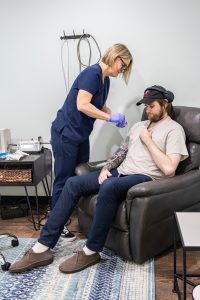
Infusions take place in private treatment rooms with continuous monitoring throughout each 45 to 60 minute session. You remain conscious and able to communicate throughout. The perceptual effects of the infusion — mild detachment, a temporary quieting of the anxious thought stream — are temporary and manageable, and our team is present throughout to address any discomfort that arises.
For patients currently on SSRIs, SNRIs, or benzodiazepines, the interaction with ketamine is assessed during intake. Many patients on these medications proceed with ketamine infusions safely. Do not discontinue or reduce existing medications independently in anticipation of starting ketamine treatment — any medication changes should occur under medical supervision.
IV ketamine for anxiety is an off-label treatment and is not typically covered by insurance. We provide documentation for patients pursuing out-of-network reimbursement, and our team discusses the full financial picture before treatment begins.
Frequently Asked Questions
Does ketamine work for anxiety if I don’t have depression? Yes. The clinical evidence for ketamine in anxiety exists independent of depression diagnoses, and the glutamate mechanism relevant to anxiety is not contingent on the presence of a comorbid mood disorder. That said, anxiety and depression co-occur frequently, and a full intake evaluation is the appropriate way to assess your specific clinical picture rather than a general rule.
How is IV ketamine different from ketamine nasal spray options? IV ketamine is administered intravenously under direct medical supervision, allowing for precise dose titration and continuous monitoring. SPRAVATO® (esketamine nasal spray) is FDA-approved specifically for treatment-resistant depression and major depressive disorder with suicidal ideation, administered in a certified healthcare setting — it is not approved for anxiety indications. IV ketamine infusions are off-label for anxiety and are what we offer at Scottsdale Ketamine Clinic.
What if my anxiety is primarily physical — chest tightness, shortness of breath, panic attacks? Somatic anxiety symptoms — those experienced primarily in the body — are part of what the glutamate and NMDA mechanism addresses. The hyperexcitable neural states that produce physical anxiety symptoms involve the same overactive signaling pathways that IV ketamine targets. Your full symptom picture, including somatic presentations, is part of the intake evaluation.
Is the research on ketamine for anxiety from reputable sources? The clinical research on ketamine for anxiety is published in peer-reviewed journals and includes studies specifically examining treatment-resistant anxiety populations. The evidence base is growing, and the National Center for Biotechnology Information’s research database includes multiple studies documenting ketamine’s anxiolytic effects. We cite the specific sources used in our clinical education materials so patients can review the underlying evidence directly.
How do I know if I’ve actually tried enough treatments to be considered treatment-resistant? The treatment-resistant threshold for anxiety disorders varies by condition and is assessed during the intake evaluation based on the treatments you have completed, the doses and durations involved, and the clinical response. If you are uncertain whether your prior trials qualify, that is a question the consultation answers — not a question you need to resolve before scheduling one.
Key Takeaways
- Clinical research documents rapid and significant ketamine-related reductions in anxiety symptoms, including in treatment-resistant populations, with effects measurable within hours of a single infusion.
- The evidence base for ketamine in anxiety is still developing relative to its depression literature, but is sufficient to support IV ketamine as a clinically reasonable option for patients who have not responded to conventional treatments.
- Ketamine targets NMDA receptors in the glutamate system — a mechanism that serotonergic and GABAergic anxiety medications do not address — and promotes neuroplasticity that may alter the neural architecture sustaining anxiety.
- Anxiety and depression frequently co-occur, and much of the robust ketamine-depression research describes populations that were also anxious, strengthening the evidence picture for mixed presentations.
- At Scottsdale Ketamine Clinic, IV ketamine is available for generalized anxiety disorder, panic disorder, and social anxiety following a thorough intake evaluation; it is off-label, not typically covered by insurance, and results vary by individual.
The evidence supports ketamine for anxiety — not as a certainty for every patient, but as a clinically grounded option for those who have not responded to the treatments that work for most people. If you have been through the standard options and are still searching for something that actually changes how your nervous system operates, a consultation at Scottsdale Ketamine Clinic is a reasonable next step. Call our Scottsdale clinic at 480-613-3226 or our Phoenix location at 480-590-6154 to schedule your free evaluation.
References
National Center for Biotechnology Information. Ketamine for Anxiety. https://pubmed.ncbi.nlm.nih.gov/31339086/
American Journal of Psychiatry. Link Between Anxiety and Depression. https://psychiatryonline.org/doi/10.1176/appi.ajp.2020.20030305
National Institutes of Health (2024). New Hope for Rapid-Acting Depression Treatment. https://www.nimh.nih.gov/news/science-updates/2024/new-hope-for-rapid-acting-depression-treatment
Medical Disclaimer
The information in this blog is for educational purposes only and does not constitute medical advice. IV ketamine infusion therapy for anxiety or any other condition should only be pursued under the supervision of a licensed medical provider familiar with your complete medical and psychiatric history. Individual results vary. Not all patients are candidates for ketamine therapy. If you are experiencing a mental health crisis or thoughts of self-harm, please call or text 988 to reach the Suicide and Crisis Lifeline or go to your nearest emergency room.