
If you’ve exhausted traditional pain management approaches for your Complex Regional Pain Syndrome, you’re likely searching for treatments that address the underlying mechanisms driving your pain rather than simply masking symptoms. Ketamine infusion therapy works fundamentally differently than conventional pain medications by targeting NMDA receptors in your brain and spinal cord — the same receptors responsible for the central sensitization and pain memory that make CRPS so resistant to standard treatments. Research shows that ketamine produces greater pain score reductions in CRPS patients than in any other chronic pain condition, with immediate relief rates of approximately 69% (Zhao et al., 2018).
Understanding NMDA Receptors: The Gateway to Pain Amplification
To understand why ketamine shows such specific promise for CRPS, we need to explore what happens at the molecular level when this condition develops. NMDA (N-methyl-D-aspartate) receptors are specialized proteins found on nerve cells throughout your nervous system. Under normal circumstances, these receptors help with learning, memory formation, and normal pain signaling. However, after an injury triggers CRPS, these same receptors become hyperactive, creating a phenomenon called central sensitization.
When you experience prolonged painful stimuli, your nerve cells release increased amounts of glutamate — a neurotransmitter that activates NMDA receptors. This activation initiates a process called long-term potentiation, where neurons strengthen their connections and become more easily triggered (McKnight et al., 2023). Think of it as your nervous system’s volume dial getting stuck at maximum. Stimuli that shouldn’t cause pain suddenly feel excruciating. This is why a light touch can trigger severe pain in CRPS — your amplified nervous system interprets gentle sensation as a threat.
Ketamine works by blocking these NMDA receptors, essentially interrupting the cycle of amplification that maintains your chronic pain state. As a dissociative anesthetic that’s been safely used for over 50 years, ketamine has unique properties that allow it to “reset” this hyperactive pain processing system. You can learn more about how we assess candidates for this treatment by reviewing our ketamine therapy FAQs.
Beyond Pain Signals: Reversing Central Sensitization
The research on ketamine for CRPS reveals effects that extend far beyond temporary pain relief. In the landmark double-blind, placebo-controlled study by Schwartzman and colleagues (2009), patients receiving ketamine infusions experienced statistically significant reductions across multiple pain parameters compared to those receiving placebo. Importantly, the placebo group showed no treatment effect whatsoever, confirming that the improvements stemmed from ketamine’s specific action on NMDA receptors rather than expectation or psychological factors.
What makes these findings particularly compelling is that ketamine appears to reverse the central sensitization process itself. Research demonstrates that the “windup” phenomenon — where repeated painful stimuli cause progressively more intense pain — decreases after ketamine treatment (Schwartzman et al., 2009). Your nervous system begins responding more proportionately to actual stimuli rather than maintaining its heightened state of alarm.
At Scottsdale Ketamine Clinic, we’ve administered ketamine for over 25 years, with our founder Jenice Hughes bringing extensive experience as a Board-Certified Nurse Anesthetist since 1997. This depth of experience with ketamine administration allows us to optimize dosing protocols specifically for CRPS treatment, using the low-dose infusion approach that research suggests provides maximum benefit with minimal side effects.
The Neuroimmune Connection: Calming Brain Inflammation
Recent research has revealed another crucial mechanism behind ketamine’s effectiveness in CRPS: neuroimmune modulation. CRPS isn’t just a pain condition — it involves significant inflammatory changes in both your peripheral tissues and central nervous system. Patients with CRPS show elevated inflammatory markers in their cerebrospinal fluid, indicating ongoing neuroinflammation (McKnight et al., 2023).
NMDA receptors aren’t only found on nerve cells. They also exist on microglia and astrocytes — the immune cells of your brain and spinal cord. When ketamine blocks these receptors, it suppresses the release of pro-inflammatory cytokines that perpetuate pain. Multiple studies have documented ketamine’s ability to rapidly reduce inflammatory markers in various patient populations, suggesting that this anti-inflammatory action contributes significantly to its pain-relieving effects in CRPS.
This dual mechanism — blocking central sensitization while simultaneously reducing neuroinflammation — helps explain why ketamine shows particular efficacy for CRPS compared to other chronic pain conditions. You’re not just masking pain; you’re addressing two fundamental processes that maintain the condition. Our broader chronic pain management services reflect this same philosophy of targeting underlying mechanisms rather than symptoms alone.
The Evidence: What Research Shows About Outcomes
A comprehensive meta-analysis examining ketamine treatment for CRPS reviewed multiple studies and found consistent results (Zhao et al., 2018). When compared to baseline pain levels before treatment, ketamine infusion led to significantly decreased pain scores across studies. The immediate pain relief event rate — defined as achieving 30% or greater pain reduction — reached 69%. Perhaps more importantly, 58% of patients maintained clinically meaningful pain relief at follow-up appointments one to three months later.
Multivariate analysis from these studies revealed something particularly noteworthy: CRPS was identified as a significant predictor of higher pain score reductions after ketamine treatment compared to other chronic pain conditions (McKnight et al., 2023). This suggests that ketamine’s mechanism of action aligns especially well with the pathophysiology of CRPS. Results vary by individual, and not all patients respond equally, but the consistency of positive outcomes across multiple research studies provides strong evidence for ketamine’s role in comprehensive CRPS treatment.
One case report documented a patient who had suffered from CRPS for 20 years achieving complete pain suppression following ketamine infusion, with pain relief lasting three to six months after a single treatment series. Some patients maintain relief for one to three years with appropriate booster infusions. While such dramatic responses aren’t universal, they demonstrate ketamine’s potential to provide meaningful, lasting relief even in long-standing, severe cases.
How Ketamine Infusion Actually Works in Practice
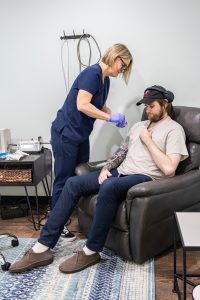
Ketamine for CRPS is administered as a low-dose intravenous infusion over a period of time, typically in a calm, controlled clinical environment. The “subanesthetic” doses used for pain treatment are far lower than those used for anesthesia — enough to engage NMDA receptors without causing complete dissociation or sedation. Research suggests that infusion rates between 15–25 mg/hour over multiple days provide optimal benefit, while rates exceeding 35 mg/hour may increase side effects without improving outcomes (McKnight et al., 2023).
During treatment, patients commonly experience a sense of relaxation and mild dissociation — feeling slightly detached from surroundings while remaining conscious and safe. Some patients describe a sense of emotional release or a temporary shift in how they perceive their pain. These effects typically resolve shortly after the infusion ends. Common side effects like mild nausea or dizziness are generally temporary and manageable.
Our team at Scottsdale Ketamine Clinic includes experienced providers with specialized training in ketamine administration and monitoring. We carefully screen patients before treatment to ensure safety, as certain medical conditions (such as uncontrolled cardiovascular issues or active psychosis) make ketamine inappropriate. This thorough evaluation process helps identify who’s most likely to benefit while minimizing risks.
Addressing Common Concerns About Ketamine Treatment
If you’re considering ketamine for CRPS, you likely have questions about safety, cost, and whether this approach is right for you. These are important considerations for anyone exploring treatment options.
Regarding safety: Ketamine has been used in medical settings for over five decades with a well-established safety profile when administered by trained professionals. Short-term effects like nausea typically resolve quickly, and research has not shown long-term side effects from appropriately dosed ketamine infusions (Schwartzman et al., 2009). At our Scottsdale and Ahwatukee locations, we provide medical monitoring throughout your treatment to ensure your comfort and safety.
Regarding insurance and cost: Many patients understandably worry about treatment expenses. While insurance coverage for ketamine infusion varies, we work with patients to understand their options and provide superbills that may be submitted for potential reimbursement. During your complimentary phone consultation, we can discuss specific financial considerations for your situation. The initial treatment series typically consists of multiple infusions over two to three weeks, with some patients benefiting from periodic booster treatments to maintain results.
Regarding treatment candidacy: Ketamine works best as part of a comprehensive approach to CRPS management. It’s not appropriate as a first-line treatment, but rather for patients who have tried multiple conventional therapies without adequate relief. If you’ve exhausted options like nerve blocks, physical therapy, and various medications, ketamine may offer a new avenue worth exploring.
Three Steps You Can Take This Week
1. Request your medical records. Compile documentation of your CRPS diagnosis, previous treatments you’ve tried, and their outcomes. This information helps treatment providers understand your history and determine appropriate next steps.
2. Research treatment centers’ experience with CRPS specifically. Not all ketamine clinics have extensive experience treating CRPS versus other conditions. Look for providers who understand the unique pathophysiology of CRPS and can discuss NMDA receptor mechanisms knowledgeably.
3. Schedule a consultation to discuss your specific case. A conversation with experienced providers can help you understand whether ketamine treatment aligns with your treatment goals, medical history, and current situation. At Scottsdale Ketamine Clinic, we offer complimentary phone consultations to discuss your concerns and answer questions.
Making an Informed Decision About Your Care
Understanding how ketamine targets the root mechanisms of CRPS — central sensitization through NMDA receptors and neuroinflammation through immune modulation — empowers you to make informed decisions about your treatment journey. While ketamine isn’t appropriate for everyone and results vary between individuals, the research supporting its use in CRPS is compelling and continues to grow.
If you’re in the Phoenix, Scottsdale, Tempe, or broader East Valley area and have been struggling with treatment-resistant CRPS, exploring ketamine infusion therapy may be worth consideration. Our team brings decades of experience with both ketamine administration and pain management, allowing us to provide care that’s both evidence-based and compassionate.
You deserve treatment that addresses the underlying causes of your pain, not just its surface symptoms. Whether ketamine proves to be the right approach for you or leads you toward other effective treatments, taking an informed, proactive role in your care is the first step toward reclaiming your quality of life.
To learn more about ketamine infusion therapy for CRPS or to schedule your complimentary consultation, call Scottsdale Ketamine Clinic at 480-590-6312 (Scottsdale) or 480-253-9710 (Phoenix). We’re here to help you if you’re hurting.
References
McKnight, J., Lavin, B., Farid-Kapadia, M., Trapp, N., Park, L., Warnecke, A., Heiss, J., & Patil, P. (2023). Ketamine for Complex Regional Pain Syndrome: A Narrative Review Highlighting Dosing Practices and Treatment Response. Pain Medicine, PMC10688501. https://pmc.ncbi.nlm.nih.gov/articles/PMC10688501/
Schwartzman, R. J., Alexander, G. M., Grothusen, J. R., Paylor, T., Reichenberger, E., & Perreault, M. (2009). Outpatient intravenous ketamine for the treatment of complex regional pain syndrome: A double-blind placebo controlled study. Pain, 147(1-3), 107-115. https://pubmed.ncbi.nlm.nih.gov/19783371/
Zhao, J., Wang, Y., & Wang, D. (2018). The Effect of Ketamine Infusion in the Treatment of Complex Regional Pain Syndrome: A Systematic Review and Meta-analysis. Current Pain and Headache Reports, 22(2), 12. https://pubmed.ncbi.nlm.nih.gov/29404715/