
Most people understand PTSD as the aftermath of a single traumatic event — a combat deployment, a car accident, an assault. Complex PTSD, by contrast, develops from prolonged or repeated trauma, often beginning in childhood or sustained across years of exposure to abuse, neglect, or chronic threat. The distinction is not just clinical terminology. It describes a fundamentally different injury to the nervous system, one that standard PTSD treatment protocols were not designed to fully address. At Scottsdale Ketamine Clinic, we work with patients whose trauma histories are not single-incident — and we understand that the treatment picture for complex trauma requires a different kind of conversation.
What Makes Complex PTSD Different
Standard PTSD involves a nervous system that became dysregulated in response to a discrete traumatic experience. The brain’s fear circuitry — centered in the amygdala, the structure responsible for detecting and responding to threat — fires repeatedly in response to reminders of the original event, producing flashbacks, hypervigilance, and avoidance behaviors (National Center for Biotechnology Information).
Complex PTSD, sometimes abbreviated as C-PTSD, involves all of those features, but layered over something more pervasive: a self-concept and an emotional regulatory system that were shaped by sustained exposure to harm, often during the developmental years when both were being formed. People with C-PTSD frequently describe a chronic difficulty regulating emotions, a persistent sense of shame or worthlessness that feels more like identity than symptom, and profound difficulty trusting others or feeling safe in relationships. These features do not emerge from a single event. They are the accumulated result of trauma that had no clear endpoint.
The clinical significance of this distinction is that C-PTSD does not always respond to the same interventions used for single-event PTSD. Prolonged exposure therapy, which works by systematically revisiting the traumatic memory until its emotional charge diminishes, can be destabilizing for patients whose trauma is not one memory but a diffuse pattern woven through years of experience. This is one reason many C-PTSD patients arrive at our clinic having tried multiple therapeutic approaches without finding adequate relief.
How Ketamine Engages the Neurobiology of Trauma
Trauma of any kind leaves neurobiological traces. In the case of complex trauma, the amygdala — which processes fear and threat — becomes chronically sensitized, responding to cues that pose no real danger as though the original threat were present (National Center for Biotechnology Information). At the same time, the prefrontal cortex, responsible for regulating emotional responses and contextualizing fear, is often functionally undermined by chronic stress. The result is a nervous system that cannot reliably distinguish past from present threat.
Ketamine works on this system through the NMDA receptor in the glutamate pathway. By blocking overactive NMDA receptors, ketamine interrupts the abnormal signaling patterns that sustain fear-based dysregulation and helps facilitate neuroplasticity — the brain’s capacity to reorganize and form new neural connections (National Center for Biotechnology Information). This neuroplastic effect is particularly relevant for complex trauma, where the goal is not simply to reduce a discrete symptom but to restore a nervous system’s capacity for flexibility, regulation, and emotional range.
Research on ketamine for PTSD consistently documents rapid and significant reductions in core symptoms including intrusive memories, hyperarousal, and emotional numbing (National Center for Biotechnology Information). For patients with treatment-resistant presentations — those who have not responded adequately to conventional PTSD therapies — ketamine’s distinct mechanism offers a pathway that does not rely on the same systems that have already proven insufficient (National Center for Biotechnology Information).
What C-PTSD Treatment Looks Like at Our Clinic
At Scottsdale Ketamine Clinic, every patient’s treatment begins with a thorough intake evaluation. For patients with complex trauma histories, this evaluation is especially important. We review your full history — including the nature and duration of the trauma, prior therapeutic approaches and how you responded, current symptoms, and your goals. Our team, led by Jenice Hughes, CRNA, a board-certified nurse anesthetist with more than four decades of clinical experience, uses that information to determine whether IV ketamine is appropriate and to build a treatment plan specific to your presentation.
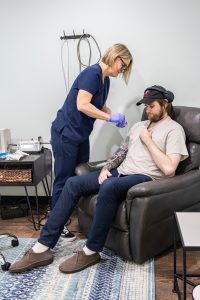
Ketamine infusions for PTSD and C-PTSD are delivered in the same private, monitored clinical setting as our other treatments. Each session lasts approximately 45 to 60 minutes, with continuous vital sign monitoring throughout. You will remain conscious and able to communicate. The perceptual effects of ketamine — mild detachment, a quieting of normal thought patterns — are temporary and resolve after the infusion ends.
We are direct about what ketamine is and is not for complex trauma patients. IV ketamine may significantly reduce symptom severity and create neurological conditions more conducive to ongoing therapeutic work. It is not a replacement for trauma-informed therapy, and we do not position it as one. For patients engaged in therapy alongside their ketamine protocol, the two approaches can be complementary — ketamine addressing the neurobiological substrate of trauma while therapy addresses the psychological and relational dimensions. Discuss with your provider how to integrate these approaches in a way that fits your specific situation. Our mental health treatment overview outlines the broader range of conditions we address if you are navigating multiple diagnoses alongside your trauma history.
The Gap Between Symptom Relief and Recovery
One of the most important things to understand about complex trauma treatment — with any modality — is that symptom reduction and recovery are related but not identical. A patient whose hypervigilance decreases and whose flashbacks become less frequent after a ketamine protocol has experienced a meaningful clinical improvement. That same patient may still have relational patterns, core beliefs about safety, and emotional regulatory habits that were shaped over years and require sustained therapeutic attention to change.
We name this not to diminish what IV ketamine may offer, but to be honest about its role. Results vary by individual. Ketamine may help create a window of neurological flexibility in which other therapeutic work becomes more accessible — some patients describe a reduced emotional charge around traumatic memories following infusions, which allows them to engage in processing work they could not previously tolerate. What happens within that window depends on the patient and the therapeutic resources they have around them.
For patients who have been told that their trauma is too complex, too old, or too pervasive to respond to treatment, we would offer a different framing: the neurobiology of complex trauma is not fixed, and approaches that operate on that neurobiology directly — rather than relying on the same systems that sustained trauma has compromised — represent a genuinely different pathway. Whether it is the right pathway for you is a question the evaluation answers, not a question we answer in advance.
A Note on Cost and Access
IV ketamine infusions are off-label treatments for PTSD and C-PTSD and are not typically covered by insurance. We provide documentation for patients who wish to seek out-of-network reimbursement from their insurer. Our team discusses the financial picture fully before any treatment begins — we do not obscure cost, and we do not pressure patients to proceed before they have the information they need to make a considered decision.
Frequently Asked Questions
How do I know if I have C-PTSD rather than standard PTSD? C-PTSD is generally associated with prolonged or repeated trauma rather than a single discrete event, and it typically involves persistent difficulties with emotional regulation, a chronically negative self-concept, and relational disruption that go beyond the core fear-based symptoms of standard PTSD. A formal diagnosis requires evaluation by a qualified mental health professional. If you suspect your trauma history fits this pattern, raise it during your consultation — it is relevant to how we approach your care.
Is ketamine appropriate if I am currently in trauma therapy? For many patients, yes. Ketamine and trauma-focused therapy can be complementary, with the neuroplastic effects of ketamine potentially creating conditions more conducive to therapeutic processing. The specifics depend on your current therapeutic approach, your clinical status, and your provider’s recommendations. Discuss this with both your therapist and our team before beginning treatment.
What if my trauma history involves substance use? Substance use history — including use developed as a response to trauma — is part of the intake evaluation and does not automatically disqualify a candidate. The nature, timeline, and current status of substance use are all relevant. We assess the full picture rather than applying a blanket rule.
Will the infusion cause me to relive traumatic memories? Ketamine does not typically cause involuntary recall of specific memories. The dissociative effects of therapeutic ketamine are generally experienced as a quieting or softening of habitual thought patterns rather than an intensification of them. Individual experiences vary, and our team is present throughout the session to support you if anything unexpected arises.
How many sessions would a C-PTSD patient typically need? Most patients begin with a foundational series of infusions, after which our team assesses response and discusses next steps including maintenance options. The number of sessions that produce meaningful benefit varies by individual. We do not apply a one-size protocol — the plan is built around your history and how your nervous system responds.
Key Takeaways
- Complex PTSD develops from prolonged or repeated trauma and involves chronic emotional dysregulation, negative self-concept, and relational disruption that go beyond the fear-based symptoms of single-event PTSD.
- The amygdala’s chronic sensitization and the prefrontal cortex’s reduced regulatory capacity are core neurobiological features of complex trauma that conventional PTSD therapies do not always address adequately.
- IV ketamine works on NMDA receptors in the glutamate system, interrupting abnormal fear-signaling patterns and promoting neuroplasticity — the capacity for the brain to reorganize and form new connections.
- Research documents rapid and significant ketamine-related reductions in PTSD symptom severity; for treatment-resistant presentations, ketamine’s distinct mechanism offers a pathway conventional approaches cannot replicate.
- At Scottsdale Ketamine Clinic, IV ketamine for complex trauma is one component of a broader care picture — not a replacement for trauma-informed therapy, but a potential neurobiological complement to it.
Many patients with complex trauma histories have been failed not by a lack of effort but by treatments that were not designed for their particular injury. If that is your experience, the consultation at Scottsdale Ketamine Clinic is a starting point — not a commitment to treatment, but a clinical conversation about whether this approach fits your situation. Results vary by individual, and we will not promise you otherwise. Call our Scottsdale clinic at 480-613-3226 or our Phoenix location at 480-590-6154 to schedule a free consultation and get a direct answer about what your options are.
References
National Center for Biotechnology Information. Fear, Stress, and the Amygdala. https://pmc.ncbi.nlm.nih.gov/articles/PMC2882379/
National Center for Biotechnology Information. Ketamine for PTSD. https://pmc.ncbi.nlm.nih.gov/articles/PMC10979792/
National Center for Biotechnology Information. Potential of Ketamine for PTSD. https://pmc.ncbi.nlm.nih.gov/articles/PMC9989422/
Medical Disclaimer
The information in this blog is for educational purposes only and does not constitute medical advice. IV ketamine infusion therapy for PTSD or complex PTSD should only be pursued under the supervision of a licensed medical provider familiar with your complete medical and psychiatric history. Individual results vary. Not all patients are candidates for ketamine therapy. If you are experiencing a mental health crisis or thoughts of self-harm, please call or text 988 to reach the Suicide and Crisis Lifeline or go to your nearest emergency room.